SponsoredWealthsimpleOpen an account — this site may earn a referral bonus at no cost to you.
Retirement Lab

Retirement Lab podcast

Short conversations on Canadian retirement planning — one topic per episode, in plain language. Hosted by Nora and Dev.

Cover art for episode 41

Episode 41 · November 13, 2026 · 3:08

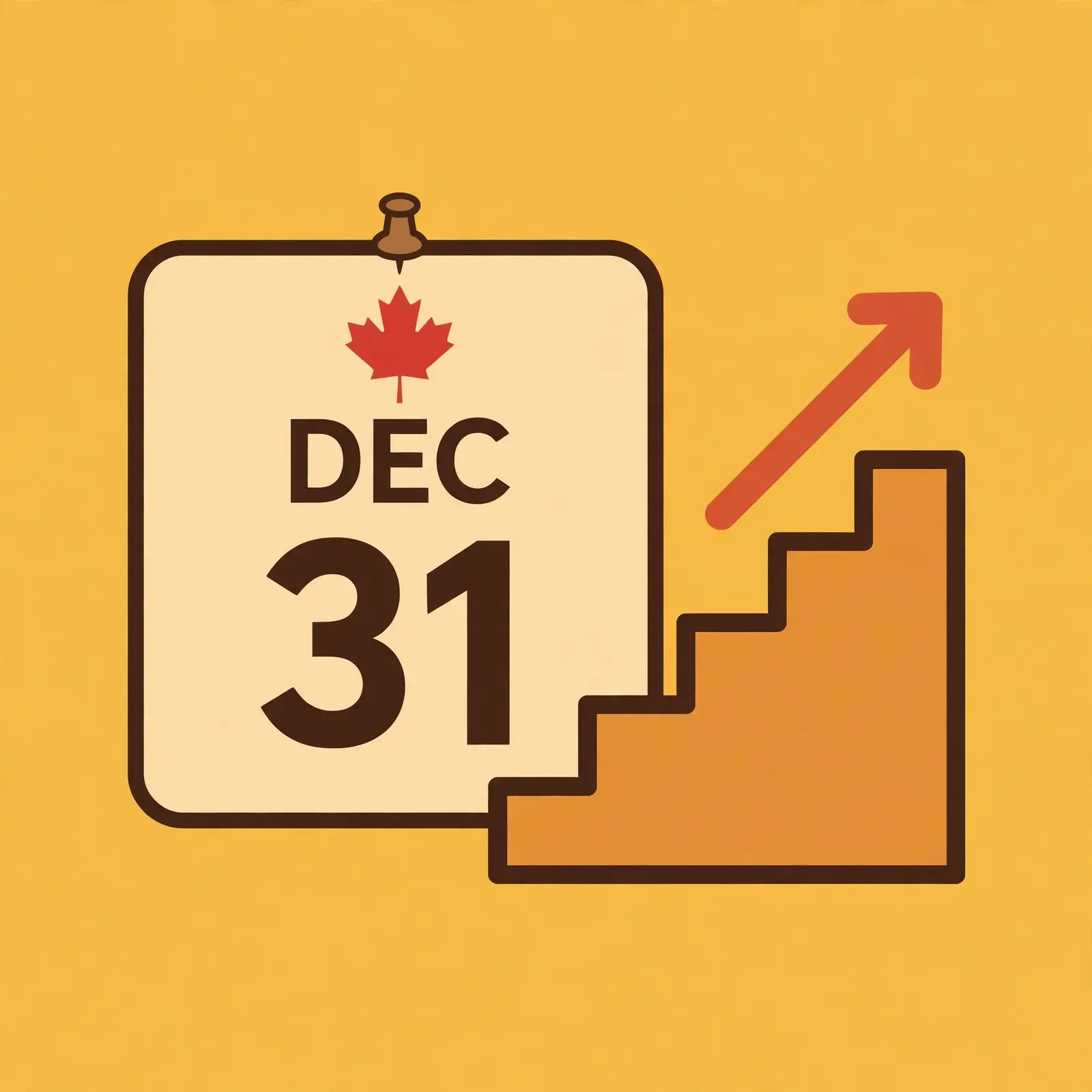
The December 31st rule at 71

Your Registered Retirement Savings Plan (RRSP) has to be wound up by December 31 of the year you turn 71 — Nora and Dev walk through the three choices, the cost of doing nothing, and why the fall beats December for getting it done.

Show notes
  • A Registered Retirement Savings Plan (RRSP) must be wound up by December 31 of the year you turn 71 — not on your birthday, the same date for everyone born that year
  • The three choices: convert to a Registered Retirement Income Fund (RRIF), buy a life annuity, or take the cash and pay tax on the whole amount in one year
  • Do nothing and the Canada Revenue Agency treats the entire balance as withdrawn at once, taxed in a single year at your highest rate
  • No minimum withdrawal is due in the conversion year; minimums start the next year at just over 5% — and basing them on a younger spouse's age lowers them
  • Spousal RRSP contributions can continue while the spouse is 70 or younger, even after your own RRSP is closed to new money
  • The free planner models the switch to a RRIF at 71 and the minimum withdrawals that follow, year by year

Cover art for episode 40

Episode 40 · November 12, 2026 · 3:33

TFSA vs RRSP in your 50s: the room question

Nora and Dev settle which account gets the next dollar in your fifties — the bracket test, the two kinds of contribution room, and why TFSA withdrawals stay invisible to benefit tests.

Show notes
  • A Tax-Free Savings Account takes money already taxed, grows tax-free, and withdrawals are tax-free too.
  • A Registered Retirement Savings Plan cuts this year's taxable income, but every dollar out later is taxed as income.
  • The bracket test: if your retirement tax rate will be lower than your working rate, the RRSP usually wins.
  • 2026 room: TFSA $7,000 a year ($109,000 total since 2009), withdrawals restore room the next January 1; RRSP room is 18% of earned income up to $33,810 and only grows while you earn.
  • TFSA withdrawals do not count as income for the Guaranteed Income Supplement or the Old Age Security clawback; RRSP and RRIF withdrawals do.
  • The free planner models yearly contributions to each account but does not check contribution room — confirm your room in CRA My Account.
Cover art for episode 39

Episode 39 · November 11, 2026 · 3:29

Pension splitting: the age-65 line that decides what counts

A workplace pension splits at any age, but RRIF money only becomes splittable at 65 — and CPP and OAS never split at all. Nora and Dev walk the age-65 line.

Show notes
  • Pension income splitting lets a couple move up to 50% of eligible pension income to the lower-earning spouse's return, on form T1032 each year
  • A workplace pension qualifies at any age; money from a Registered Retirement Income Fund (RRIF) only qualifies from age 65 onward
  • A 62-year-old couple living on $40,000 of RRIF income cannot split a dollar — at 65 they can move up to $20,000
  • The Canada Pension Plan (CPP) and Old Age Security (OAS) can never be split on a tax return; CPP pension sharing through Service Canada is a separate lever that divides the actual pension
  • Splitting can pull the higher earner under the 2026 Old Age Security clawback threshold of $95,323, but it does not help the Guaranteed Income Supplement (GIS), which tests combined income
  • The planner optimizes the pension-splitting election every year within the legal 50% cap

Read the full guide →

Cover art for episode 38

Episode 38 · November 10, 2026 · 3:10

RRIF minimums: the forced withdrawals after 71

By December 31 of the year you turn 71 your RRSP has to become a RRIF, and the minimum withdrawals after that run on the tax department’s schedule, not yours.

Show notes
  • A Registered Retirement Income Fund (RRIF) forces a minimum withdrawal every year, set by a percentage of the January 1 balance — 5.28% at 71, climbing to 20% at 95 and older
  • No minimum is due in the conversion year; the first forced withdrawal lands at 72, at 5.40%
  • On a $300,000 RRIF the age-72 minimum is about $16,200, all taxable income, stacking on Canada Pension Plan (CPP) and Old Age Security (OAS)
  • Drawing the Registered Retirement Savings Plan (RRSP) down deliberately in your 60s at lower rates beats letting minimums force it out at higher rates in your 80s
  • Levers: base the minimum on a younger spouse’s age (one-time election), and Manitoba’s one-time 50% unlock on locked-in accounts
  • The planner models RRIF minimums from age 72 onward automatically

Read the full guide →

Cover art for episode 37

Episode 37 · November 9, 2026 · 3:36

GIS: the part-time job that doesn't cost you your benefit

The GIS earnings exemption means the first $5,000 of part-time work doesn't touch your benefit — while the same money from an RRSP counts in full.

Show notes
  • The Guaranteed Income Supplement (GIS) is a tax-free top-up for low-income Old Age Security (OAS) recipients — about $1,139 a month for a single senior this quarter
  • The GIS earnings exemption: the first $5,000 of work income is fully exempt, and half of the next $10,000 is exempt too
  • $10,000 of part-time work puts only $2,500 into the GIS calculation; the same $10,000 from a Registered Retirement Savings Plan (RRSP) counts in full
  • GIS is recalculated every July from the previous year's income, so one big withdrawal can shadow a full year
  • Tax-Free Savings Account (TFSA) withdrawals aren't income at all, so they don't touch GIS
  • The free Retirement Lab planner models GIS year by year, including the earnings exemption

Read the full guide →

Cover art for episode 36

Episode 36 · November 8, 2026 · 3:33

OAS clawback: the levers that keep you under the tripwire

Nora and Dev move past the clawback threshold itself and into the levers that keep you under it — Tax-Free Savings Account withdrawals that do not count, smoothing Registered Retirement Savings Plan draws, and splitting pension income with a spouse.

Show notes
  • The clawback takes back 15 cents of Old Age Security for every dollar of net income over the threshold — $95,323 for 2026 income
  • The threshold is per person, not per household, so a couple gets two thresholds
  • Tax-Free Savings Account withdrawals do not count as income for the clawback, while Registered Retirement Savings Plan withdrawals count in full
  • Splitting eligible pension income with a spouse can pull the higher earner back under the line
  • Your 2026 income sets the Old Age Security you receive from July 2027 to June 2028, so one big withdrawal shadows a full year of pension
  • The planner shows your Old Age Security after the clawback, year by year, so you can test a different withdrawal order before committing

Read the full guide →

Cover art for episode 35

Episode 35 · November 7, 2026 · 3:14

CPP child-rearing, part two: the drop-in credit most parents miss

Nora and Dev return to the child-rearing provision for the half most parents never hear about — the drop-in credit, which parent should claim it, and how to ask even if you are already collecting CPP.

Show notes
  • The provision has two halves: the drop-out protects the base CPP component, the drop-in protects the enhanced component for months after January 1, 2019.
  • Drop-in credits are based on your earnings in the five years before you became the primary caregiver, and only apply when they beat your actual earnings.
  • Only one parent can claim the months for a given child — the primary caregiver, the one most responsible for the child's day-to-day needs.
  • You can still claim while already collecting CPP, through My Service Canada Account or the separate child-rearing form.
  • The planner's CPP estimator asks about years out of work raising young kids and factors the dropout in — try it at https://canadian-retirement-lab-v2.netlify.app/start.
  • Educational content only — not financial advice.
Cover art for episode 34

Episode 34 · November 6, 2026 · 3:06

Downsizing: what if you sell and rent instead?

Nora and Dev take downsizing one step further: what if you sell and rent instead of buying smaller? They compare the true yearly cost of owning with rent, and how the planner tests both paths.

Show notes
  • Selling and renting skips the second purchase entirely: no land transfer tax, no second legal fees, and the full net proceeds go into savings
  • The gain on the home you live in is usually tax free under the principal residence exemption, whether you buy again or rent
  • Rent rises with inflation and leaves no house to sell or leave behind, while owning ties money up but the home usually holds its value
  • Compare honestly: the true yearly cost of owning — tax, insurance, maintenance, and the returns forgone on tied-up equity — against the rent
  • The free planner models both paths: a home sale at the age you choose, then buy a cheaper home or rent, with rent charged from the sale age onward
  • Renting means a landlord makes some decisions, so keep a cash cushion and a backup plan if a move is forced
Cover art for episode 33

Episode 33 · November 5, 2026 · 3:14

Sequence risk: the five years before you retire

Nora and Dev flip sequence risk around: the five years before you retire can matter as much as the five after, because a market drop costs more when your savings are at their largest.

Show notes
  • A market drop costs more in dollars near retirement because the balance is at its largest, and the rebuild window is nearly closed
  • Sequence risk spans the whole crossing: the last working years plus the first retired years, so a rough stretch at the boundary hits twice
  • Delaying retirement by a year or two adds contributions, growth, and one fewer year your savings must cover
  • Part-time work as a bridge lets the paycheque cover the bills while savings keep compounding untouched, and the planner models downshifting year by year
  • A cash cushion and easing off the riskiest investments near the date keep one bad year from rewriting the plan
  • The planner stress test runs 500 market paths and shows how often your money lasts — that is where sequence risk shows up in your own numbers
Cover art for episode 32

Episode 32 · November 4, 2026 · 3:10

How inflation quietly rewrites your plan every year: what moves and what stands still

Nora and Dev look past prices to the rules themselves: which benefits and tax brackets rise with inflation, why Manitoba's frozen brackets mean bracket creep, and the three-list check for your own plan.

Show notes
  • Canada Pension Plan rises each year with the cost of living, and Old Age Security adjusts every three months
  • The Guaranteed Income Supplement is an extra monthly top-up for lower-income seniors who already receive Old Age Security, and it rises with the cost of living too
  • Federal tax brackets and credits are indexed to inflation, which stops you drifting into higher brackets without being better off
  • Manitoba's provincial brackets are frozen at $47,000 and $100,000, so income that only keeps pace with prices can still land in a higher Manitoba bracket
  • Workplace pensions split: indexed pensions keep pace, fixed pensions shrink in real terms every year, so check your own plan documents
  • The free planner uses one inflation rate you set, two percent by default, and shows everything in today's dollars
Cover art for episode 31

Episode 31 · November 3, 2026 · 3:15

Non-registered investing: the tax bill you pay before you sell

Nora and Dev look at the tax a non-registered account can trigger before anything is sold: yearly fund distributions, the cost base that stops double taxation, and the loss rule that can park a deduction.

Show notes
  • Fund distributions are taxed in the year they arrive, even when automatically reinvested and no cash is taken out
  • Reinvested distributions raise your adjusted cost base, so tracking it yourself stops you paying tax twice on the same money
  • Return of capital is not taxed as income when received, but it lowers your cost base, so the tax is postponed rather than gone
  • The superficial loss rule denies a loss for the year if you or your spouse buys the same investment back within thirty days before or after the sale
  • Only the gain portion of a non-registered withdrawal is taxed, unlike a registered retirement savings plan withdrawal, which is fully taxable income
  • The free planner compares withdrawal orders on an after-tax basis, but it does not keep your adjusted cost base records for you
Cover art for episode 30

Episode 30 · November 2, 2026 · 3:17

The widow/widower tax hit: deadlines, designations, and the survivor benefit

Nora and Dev return to the widow's tax year with the part couples can still control: the rollover deadline, the TFSA designation, and the survivor benefit people miss.

Show notes
  • Registered plan rollovers to a surviving spouse are tax-deferred, but must land by December 31 of the year after the death
  • Naming a spouse as TFSA successor holder keeps the account growing tax-free; a beneficiary spouse must move the money by the same deadline and file a form
  • The Allowance for the Survivor is a monthly tax-free payment for low-income survivors aged 60 to 64, up to $1,726.18 a month for October to December 2026, and it must be applied for
  • A CPP survivor benefit plus the survivor's own pension cannot exceed the maximum retirement pension for the year
  • The free planner runs a household plan to age 90 but does not model a survivor scenario yet, so work through that piece on paper or with a tax professional
Cover art for episode 29

Episode 29 · November 1, 2026 · 3:24

OAS deferral to 70: how to pay for the five-year wait

Delaying Old Age Security buys a cheque thirty-six percent bigger, for life — but the five-year wait has to be funded from somewhere. Nora and Dev price the bridge.

Show notes
  • The maximum Old Age Security payment is seven hundred sixty-two dollars and fifty cents a month at ages sixty-five to seventy-four for October to December twenty twenty-six, or about one thousand thirty-seven dollars deferred to seventy
  • Five years without that cheque means giving up more than forty-five thousand dollars at the maximum, so the wait needs a funding plan
  • Tax-free savings account withdrawals add no taxable income, while registered retirement savings plan withdrawals are fully taxable and can push you into a higher bracket
  • Part-time work while you wait avoids clawback on a cheque that is not being paid yet, but forced withdrawals later can still trigger the clawback on the bigger cheque
  • Delaying Old Age Security also means no Guaranteed Income Supplement in those years, so the wait usually does not pay for low-income seniors
  • The free planner lets you set your Old Age Security start age from sixty-five to seventy and see the year-by-year effect, including tax and clawback
Cover art for episode 28

Episode 28 · October 31, 2026 · 3:27

CPP at 60 vs 65 vs 70: what the break-even chart leaves out

Nora and Dev look past the break-even chart for Canada Pension Plan timing: how tax stacking, the bridge years before seventy, and other benefits change whether sixty, sixty-five, or seventy is the right start age.

Show notes
  • The Canada Pension Plan pays a monthly income for life, and the age you start it, from sixty to seventy, changes the cheque permanently.
  • Current figures: the maximum at sixty-five is $1,507.65 a month for 2026 starts, $964.90 at sixty, $2,140.86 at seventy; the average new pension at sixty-five is $858.34.
  • The CPP cheque is fully taxable and stacks on employment income or Registered Retirement Savings Plan withdrawals, which can push income into a higher bracket.
  • Delaying to seventy means funding the wait from savings; Tax Free Savings Account withdrawals add no taxable income, which keeps the bridge years cheaper.
  • Old Age Security does not have to start with CPP, and CPP counts as income against the Guaranteed Income Supplement.
  • The free planner lets you set a CPP start age from sixty to seventy and shows the year-by-year effect on your own numbers.
Cover art for episode 27

Episode 27 · October 30, 2026 · 3:10

Home equity: what staying in the house really costs

Nora and Dev revisit home equity from the other side: what the house you keep really costs to carry, and why selling trades one bill for another.

Show notes
  • A paid-off house still sends bills every year: property tax, insurance, heat and hydro, plus the big irregular costs like a roof or furnace.
  • Staying versus moving is a comparison of yearly bills, not a lump sum versus nothing.
  • Selling and renting trades house bills for rent, and rent never ends and keeps rising, so the trade has to be compared year by year.
  • Equity never unlocked during life becomes inheritance, not retirement income, so a plan that needs the money should name the age it comes out.
  • The free planner keeps home value separate from spendable savings and models a sale or downsize at the age you would actually move, with selling costs and land transfer tax included.
Cover art for episode 26

Episode 26 · October 29, 2026 · 3:30

RRIF minimums: the forced withdrawals after 71

How RRIF minimums work after 71, why they stack on top of CPP and OAS, and the planning moves worth making in your 60s.

Show notes
  • RRSPs must be wound up by December 31 of the year you turn 71, usually by converting to a RRIF
  • The minimum is a percentage of the January 1 balance that climbs with age, from 5.28% at 71 to 20% from 95
  • Minimums are fully taxable and stack on CPP, OAS and pension income, which can push you into higher brackets or OAS clawback territory
  • Drawing the RRSP down deliberately in your 60s can shrink later forced withdrawals
  • The younger-spouse age election lowers minimums but must be chosen when the RRIF is opened and cannot be changed

Read the full guide →

Cover art for episode 25

Episode 25 · October 28, 2026 · 3:29

The 4% rule, Canadian edition: which account you take it from

Nora and Dev take on the part of the 4% rule nobody talks about: which account you draw from, and how that choice changes the tax you actually pay.

Show notes
  • The 4% rule tells you how much to take each year, but never which account to take it from, and the account changes the after-tax result.
  • Registered Retirement Savings Plan and Registered Retirement Income Fund withdrawals are fully taxable, while Tax Free Savings Account withdrawals come out tax free.
  • Forced Registered Retirement Income Fund minimums start just over 5% at 71 and climb with age, so they can push withdrawals past 4% whether you planned to spend that much or not.
  • Drawing down the Registered Retirement Savings Plan deliberately in your 60s can mean smaller forced withdrawals later; spending the Tax Free Savings Account first protects registered money but leaves a bigger end-of-life tax bill.
  • The rule was designed for 30 years, and the bridge years before Canada Pension Plan and Old Age Security start put the whole spending load on savings alone.
  • The free planner compares four withdrawal orders side by side, year by year to age 90, with mandatory minimums taken first.
Cover art for episode 24

Episode 24 · October 27, 2026 · 4:00

GIS and the July reset: why one withdrawal shadows a whole year

Nora and Dev explain the Guaranteed Income Supplement's July recalculation: why a single lump-sum withdrawal can depress GIS for a full payment year, and how timing, the employment exemption, and the Tax Free Savings Account change the picture.

Show notes
  • GIS is recalculated every July from the previous calendar year's income, so one year's withdrawal lowers the supplement for the following twelve months.
  • Spreading a withdrawal across two calendar years can keep income below the cutoff in each year, where one lump sum would wipe out the supplement.
  • The first $5,000 of employment income does not count toward GIS, and only half of the next $10,000 counts; Registered Retirement Savings Plan withdrawals count in full.
  • Tax Free Savings Account withdrawals do not count as income and do not touch GIS.
  • You generally cannot receive GIS while deferring Old Age Security, and if income drops you can ask Service Canada to use an estimated current-year income.
  • Try different withdrawal orders in the free planner, which models GIS year by year with the statutory formula.
Read the full guide →

Cover art for episode 23

Episode 23 · October 26, 2026 · 3:33

TFSA vs RRSP in your 50s: why the answer changes as you age

Nora and Dev track how the TFSA-versus-RRSP answer shifts as you move through your fifties, from peak-earning deductions to the gap years before seventy-one.

Show notes
  • The core trade: a Registered Retirement Savings Plan deduction now versus tax-free Tax Free Savings Account withdrawals later, decided by your tax rate today versus in retirement.
  • In your early fifties, peak earnings usually make the Registered Retirement Savings Plan deduction win.
  • After seventy-one, forced Registered Retirement Income Fund withdrawals can push income into higher brackets or over the Old Age Security clawback threshold.
  • The gap years between retirement and seventy-one can be a sweet spot for deliberately drawing down the Registered Retirement Savings Plan at a low tax rate.
  • Try different contribution splits in the free planner and compare the projection.
Cover art for episode 22

Episode 22 · October 25, 2026 · 3:11

The December 31st rule at 71: the numbers and levers after you convert

Nora and Dev revisit the age-71 RRSP deadline from a new angle: the prescribed withdrawal percentages that follow conversion, a worked example, and the younger-spouse levers worth deciding deliberately.

Show notes
  • No minimum withdrawal in the year you convert; the first minimum comes the year after, as a prescribed percentage of the January 1 value
  • The percentages climb with age: 5.4% at 72, 6.82% at 80, 11.92% at 90, and 20% from 95 on
  • Worked example: a $400,000 RRIF at 72 forces out $21,600 of taxable income
  • You can elect to base minimums on a younger spouse's age, but only at setup and before the first payment, and the election is permanent for that RRIF
  • December 31 of the year you turn 71 is also your last day to contribute to your own RRSP, so plan the conversion in the fall
Cover art for episode 21

Episode 21 · October 24, 2026 · 3:24

Pension splitting: the yearly dial you can re-tune

Nora and Dev revisit pension splitting from a new angle: it is an annual election, not a one-time setup, so the best split changes as your incomes change year to year.

Show notes
  • Pension splitting is an annual election: you choose fresh each tax year, from nothing up to fifty percent of eligible pension income.
  • An employer pension qualifies at any age; registered retirement income fund withdrawals qualify from sixty-five; lump-sum registered retirement savings plan withdrawals never qualify.
  • Your best split changes year to year: a quiet year may call for a small split, while a clawback year may call for a large one.
  • The fifty percent cap is per income source per year, and the split is paper-only: no money changes hands.
  • Splitting does not help couples qualify for the Guaranteed Income Supplement, which tests combined household income.
  • The free planner optimizes the splitting election every year within the legal fifty percent limit.

Read the full guide →

Cover art for episode 20

Episode 20 · October 23, 2026 · 3:29

The OAS clawback you walk into: RRIF minimums and the sixties fix

Nora and Dev revisit the OAS clawback from a new angle — how RRIF minimums rise on the CRA's schedule and can push a retiree over the ninety-five-thousand-dollar tripwire without any change in lifestyle, and why the sixties are the years to act.

Show notes
  • For 2026 the clawback starts at $95,323 of individual net income; above it you repay 15 cents of OAS per dollar.
  • RRIF minimums start near 5.3% and climb to about 6.9% by 80, 8.5% by 85 and close to 12% by 90 — far faster than inflation indexes the threshold.
  • That gap means the forced taxable income rises every year, and a retiree under the tripwire at 72 can drift over it by 80 on the same portfolio.
  • The fix is in your 60s: a deliberate RRSP meltdown at lower brackets, the low-income gap between retirement and 71, and pension splitting from 65.
  • The free planner models the clawback every year, so you can see exactly when your income crosses the tripwire under different withdrawal orders.

Read the full guide →

Cover art for episode 19

Episode 19 · October 22, 2026 · 3:24

GIS for couples: the combined-income test

Nora and Dev explain why the Guaranteed Income Supplement is tested on your combined household income: one spouse's big RRSP withdrawal can shrink both partners' cheques, and pension splitting won't save you.

Show notes
  • GIS is tested on combined household income, not per person — one threshold, one combined number (Oct–Dec 2026: both on OAS, up to $685.56 each, combined under ~$30,528; spouse not on OAS, up to $1,138.90, combined under ~$55,392).
  • The couple's trap: one spouse's big RRSP withdrawal raises the combined number and shrinks the other's GIS by about 50 cents per dollar in the phase-out range.
  • Pension splitting does NOT help GIS — it moves dollars between spouses but the combined total is unchanged (unlike the OAS clawback, where it helps).
  • What protects GIS for couples: spend TFSA not RRSP (TFSA withdrawals aren't income); coordinate big withdrawals by running the combined math first.
  • Two relief valves: the first $5,000 of employment income doesn't count toward GIS; Service Canada can recalculate GIS on current-year estimated income after a sharp drop (e.g. retirement year) — you have to ask.
  • The free planner at canadian-retirement-lab-v2.netlify.app/start models GIS year by year and compares all four withdrawal orders. Educational content only — not financial advice.
Read the full guide →

Cover art for episode 18

Episode 18 · October 21, 2026 · 3:04

OAS Clawback: What Counts as Income (and What Doesn't)

Nora and Dev revisit the OAS clawback from a new angle — which dollars actually land in the clawback formula: per-person testing, RRSP lump sums, the TFSA exemption, and the July-to-June recovery cycle.

Show notes
  • The clawback test is per person, not per couple — each spouse can earn up to the threshold with no clawback.
  • RRSP and RRIF withdrawals count in full; a big lump-sum draw can trigger a clawback on top of the extra tax.
  • TFSA withdrawals don't count at all — they aren't income, so the clawback formula never sees them.
  • For the 2026 income year the tripwire is $95,323 of individual net income; above it you repay 15 cents of OAS per dollar.
  • The CRA collects it by reducing monthly OAS starting the following July; payments recover if your income drops back down.
  • Legitimate ways to shrink it: smooth RRSP draws, split pension income, or defer OAS — and the free planner models the clawback every year.

Read the full guide →

Cover art for episode 17

Episode 17 · October 20, 2026 · 3:25

Downsizing: the math beyond the sticker price

Nora and Dev walk through the real arithmetic of downsizing — why a two-hundred-thousand-dollar price gap leaves far less in your pocket once commissions, transfer taxes, condo fees and moving costs take their cut.

Show notes
  • The sticker-price gap isn't the profit: both sides of the move have costs that eat it.
  • Selling costs: realtor commission, legal fees, repairs and staging, moving.
  • Buying costs: land transfer tax (one to two percent, varies by province; some cities add their own).
  • Ongoing costs people forget: condo fees and the property-tax difference between the old and new place.
  • Principal-residence exemption — but partial-rental history can make part of a gain taxable.
  • Test the move in the free planner before deciding: https://canadian-retirement-lab-v2.netlify.app/start.
Cover art for episode 16

Episode 16 · October 19, 2026 · 2:35

The CPP Child-Rearing Provision: Don't Let Stay-at-Home Years Shrink Your Pension

Nora and Dev explain how the CPP child-rearing provision can lift your pension if you spent years home with young kids — and why you have to ask for it.

Show notes
  • Your CPP is built from your best earning years — years home with kids under seven would drag the average down without this provision.
  • Claiming it drops those low-earning years out and fills them with your earnings from the years before the kids were born.
  • Qualifiers: primary caregiver, child under seven, household got the child benefit cheques; either parent can claim.
  • It is not automatic and covers back to 1959 — many retirees are on a smaller CPP simply because they never applied.
  • Check your Service Canada statement; applying costs nothing and can only raise your pension.
Cover art for episode 15

Episode 15 · October 18, 2026 · 2:41

Sequence Risk: Why the First Five Years of Retirement Matter Most

Two retirees, the same average returns, very different outcomes — the order the market delivers its good and bad years decides the plan.

Show notes
  • What sequence of returns risk is: it's the order of returns, not the average, that can make or break a thirty-year plan
  • The double hit: selling investments to fund withdrawals while the market is down permanently destroys recovery potential
  • The scary case: retiring just before crashes like 2000 or 2008 shows how fast an account can shrink when withdrawals and a downturn collide
  • Defences that work: a one-to-two-year cash buffer, flexible withdrawals in down years, and dialling back stock risk near retirement
  • Why indexed income helps: CPP and OAS payments are untouched by market crashes
Cover art for episode 14

Episode 14 · October 17, 2026 · 3:26

How inflation quietly rewrites your plan every year

At two percent a year, prices double roughly every thirty-five years — here is how inflation silently rewrites a retirement plan, and what to do about it.

Show notes
  • The Bank of Canada's two percent target, and what it does to prices over a thirty-five-year retirement
  • The twenty twenty-two reminder: Canadian inflation peaked at eight point one percent that June
  • Indexed versus fixed income: why C P P and O A S keep up while fixed pensions shrink in real terms
  • Nominal versus real returns, and why tax is charged on the nominal gain
  • Cash drag: savings rates at or below inflation mean quietly going backwards
  • The planner move: build an inflation assumption in and check it every year, in today's dollars
Cover art for episode 13

Episode 13 · October 16, 2026 · 3:26

Non-registered investing: capital gains vs interest

In a non-registered account, every dollar of growth is taxed differently — interest in full, capital gains at half, and eligible Canadian dividends in between. Nora and Dev run the numbers on what that really costs.

Show notes
  • The three flavours of investment income in a non-registered account: interest is fully taxable, capital gains get the 50% inclusion rate, and eligible Canadian dividends sit in between.
  • A worked comparison at a 40% marginal rate: one thousand dollars of interest costs about four hundred in tax, while the same gain as capital gains costs about two hundred.
  • Foreign dividends are the exception — taxed like interest, with withholding tax skimmed first and only partly offset by the foreign tax credit.
  • The asset-location play: hold interest-earning GICs and bonds inside the RRSP or TFSA first, and save non-registered room for capital gains and eligible Canadian dividends.
  • Capital losses can only offset capital gains, not other income — but they carry back three years or forward indefinitely.
Cover art for episode 12

Episode 12 · October 14, 2026 · 3:28

The widow/widower tax hit nobody plans for

When one spouse dies, the survivor files alone at single-person brackets, loses a full OAS cheque overnight, and can still get clipped by the OAS clawback — while the RRSP rollover only defers the tax and the TFSA successor holder designation is the one account that keeps everything intact.

Show notes
  • Canada has no joint tax return: the survivor becomes one taxpayer at single-person brackets, and pension income splitting stops being available for their future returns.
  • An RRSP or RRIF can roll to the surviving spouse tax-deferred if it lands in their own account by December 31 of the year after death — but the rollover moves the tax, it does not erase it.
  • CPP pays a survivor benefit capped so the combined amount never exceeds the maximum retirement pension; OAS itself stops outright — the program's only survivor support is the Allowance for the Survivor, for low-income spouses aged 60 to 64.
  • The survivor's smaller income can still top the OAS clawback threshold (about $95,323 for 2026) and cost them part of their own OAS.
  • A TFSA with a successor holder designation passes tax-free with the room intact — checking that the designation is filled out is a ten-minute job.
  • Moves that soften the hit years ahead: drawing down registered accounts in your sixties at lower combined brackets, and shifting growth into the TFSA.
  • Episode correction (October 20, 2026): one line in this episode says the planner models both spouses' outcomes side by side. It doesn't yet — the planner runs your household plan to age 90 and doesn't model a survivor scenario. See the methodology page for exactly what it does model.
Cover art for episode 11

Episode 11 · October 13, 2026 · 3:13

The December 31st rule at 71

By December 31st of the year you turn 71, your RRSP must become a RRIF, an annuity, or cash — and doing nothing triggers the worst possible tax outcome.
Show notes
  • The hard deadline: December 31st of the calendar year you turn 71, regardless of your birthday
  • The three exits: convert to a RRIF, buy an annuity, or take the cash
  • Why a RRIF conversion is just a name change — no tax bill, investments move over as-is
  • What happens if you do nothing: the full balance becomes taxable income at once
  • Why October or November is the right month to handle the paperwork, not December
  • The last RRSP contribution year is also age 71, with its own December 31st deadline

Cover art for episode 10

Episode 10 · October 12, 2026 · 3:09

OAS deferral to 70: when it pays and when it doesn't

Delaying Old Age Security from 65 to 70 grows your monthly cheque by thirty-six percent, for life — but it is not the right move for everyone.

Show notes
  • How the 0.6% monthly deferral bonus works, up to 36% more at age 70
  • Real numbers: the maximum OAS cheque at 65 versus the deferred amount at 70
  • The breakeven age, and why the decision hinges on your situation, not your health
  • Three cases where deferring pays: still working, longevity, not needing the cash yet
  • When to take it at 65: health concerns, needing the money, or GIS recipients
  • The wrinkle: deferring can feed a bigger cheque to the clawback in your 70s and 80s
Cover art for episode 9

Episode 9 · October 11, 2026 · 3:17

CPP at 60 vs 65 vs 70: the real math

The thirty-six percent haircut at sixty, the forty-two percent boost at seventy, the breakeven age that separates the two bets, and the tax wrinkle that changes everything.

Show notes
  • CPP shrinks by 0.6% for every month you start before 65 — starting at 60 cuts your cheque by 36%, for life — and grows 0.7% a month after 65, up 42% by 70.
  • For 2026 the maximum is $1,507.65 a month at 65 ($964.90 at 60, $2,140.86 at 70), but the average new pension is only about $858 — check your own number in your My Service Canada Account.
  • Sixty fits when you need the money or health is a factor; 65 is the default; 70 is the longevity play — the cheapest lifetime annuity you will ever buy.
  • Keep working while collecting before 70 and each year buys a small Post-Retirement Benefit on top of the early pension.
  • The breakeven: an early starter collects five extra years of cheques, and the bigger late pension takes about twelve to thirteen years to catch up in total dollars.
  • CPP is fully taxable income — a bigger age-70 cheque can collide with forced RRIF withdrawals and the OAS clawback, so the timing decision never happens in a vacuum.
Cover art for episode 8

Episode 8 · October 10, 2026 · 3:24

Why Your Home Equity Is Not a Retirement Plan (Until You Sell)

The downsizing math behind the sticker price — realtor fees, transfer tax, moving costs — and why a house you live in pays no groceries.

Show notes
  • Home equity is wealth on paper: while you live in the house, it is a home, not a paycheque — and it keeps sending you bills (property tax, insurance, maintenance).
  • Selling an $800,000 home to buy a $500,000 condo is not $300,000 in your pocket — realtor commissions, land transfer tax, legal fees, moving and renos eat roughly $60,000 of it.
  • Many people reach their seventies and don't actually want to leave the neighbourhood — plans shouldn't count money that will never be unlocked.
  • Borrowing against the house is costly: HELOC payments come out of the retirement budget, and reverse mortgages compound against you at higher rates.
  • Rule of thumb: only count the net cash you'd walk away with after all costs, at the age you'd actually sell.
Cover art for episode 7

Episode 7 · October 9, 2026 · 3:29

The 4% Rule, Canadian Edition

Bengen's famous rule gets a Canadian stress test — taxes, CPP/OAS, and why 4% is a starting point, not a law.

Show notes
  • The 4% rule comes from Bill Bengen's 1994 study: a 4% first-year withdrawal survived every 30-year US window, even retiring in 1966 — worst-case armor, not average-case planning.
  • In Canada, RRSP/RRIF withdrawals are fully taxable, so 4% of the portfolio is not 4% of spending money — at a ~30% marginal rate it's closer to 2.8%.
  • CPP, OAS, and workplace pensions cover part of spending so the portfolio does less work — but the OAS clawback (about $95,323 for 2026) can erode that floor when forced RRIF minimums push income over it.
  • Bengen never tested the rule on a made-in-Canada portfolio, which tilts heavier toward banks, energy, and resources.
  • Treat 4% as the start of the conversation: 3.5% for margin of safety, spend-more-early patterns, guardrails, and annual after-tax re-checks matter more than a perfect starting number.

Read the full guide →

Cover art for episode 6

Episode 6 · October 8, 2026 · 3:47

TFSA vs RRSP in Your 50s: Which to Feed First

The deduction trade-off, the tax-free flexibility play, and the split-the-difference rule of thumb for your fifties.

Show notes
  • RRSP contributions earn a deduction now worth your marginal tax rate — a real discount in peak earning years — but every withdrawal later is fully taxable.
  • TFSA contributions get no deduction, but growth and withdrawals are tax-free and don't count as income toward OAS clawback or GIS limits.
  • TFSA room comes back after a withdrawal (plus the new annual limit); RRSP room is gone forever once withdrawn.
  • RRSP-first fits high earners with small RRSP balances expecting lower retirement income; TFSA-first fits moderate earners with pensions or big RRSPs worried about forced RRIF withdrawals.
  • Practical middle path: feed the RRSP enough to drop out of your top bracket, then put the rest in the TFSA.
Cover art for episode 5

Episode 5 · October 7, 2026 · 3:43

Pension Splitting: Shifting Income to the Lower-Earning Spouse

How couples can shift up to half of eligible pension income to the lower-earning spouse and pay less tax as a household.

Show notes
  • Couples can shift up to 50% of eligible pension income to the lower-earning spouse's tax return — no money actually changes hands.
  • It works because Canada taxes individuals: two smaller tax bills usually beat one big one.
  • What qualifies: employer pensions at any age, RRIF withdrawals from age 65; elect each year on form T1032.
  • It can also pull the higher earner under the OAS clawback threshold, rescuing OAS payments.
  • Limits: 50% cap per source, doesn't create GIS eligibility, and Quebec has its own provincial rules.

Read the full guide →

Cover art for episode 4

Episode 4 · October 6, 2026 · 2:58

RRIF Minimums: The Forced Withdrawals After 71

The CRA's deadline is December 31 of the year you turn 71 — and from 72 onward, a rising percentage of your balance must come out every year, on the CRA's schedule, not yours.

Show notes
  • By December 31 of the year you turn 71, each RRSP must be converted to a RRIF, used to buy an annuity, or withdrawn in full and taxed.
  • Starting the year after conversion, you must withdraw at least a set percentage of the RRIF's January 1 balance each year — just over 5% at 71, climbing with age.
  • Minimums are fully taxable income. You can always take out more, but never less; amounts above the minimum face 10–30% withholding tax as a prepayment.
  • Forced withdrawals stack on top of CPP, OAS, and pension income, often pushing retirees into higher brackets and OAS clawback territory in their late 70s and 80s.
  • The minimum percentage can be based on a younger spouse's age — elected once at RRIF setup, it can't be changed later.
  • A LIRA from an old pension converts to a LIF under the same 71 deadline, with both minimums and maximums each year.

Read the full guide →

Cover art for episode 3

Episode 3 · October 5, 2026 · 3:25

GIS: the benefit that punishes RRSP withdrawals

Why every dollar of RRSP withdrawals can cost a low-income senior twice — and how a deliberate melt-down in your sixties can protect the supplement.

Show notes
  • For a single senior with almost no income, GIS pays up to about $1,123 a month, tax free, on top of OAS.
  • RRSP withdrawals count as income in full, so they raise your tax bill and shrink your GIS cheque at the same time.
  • TFSA withdrawals are not income at all, so they leave GIS untouched — the usual first source of spending money.
  • Drawing the RRSP down deliberately in your sixties can shrink the balance before mandatory RRIF withdrawals at 72 erode GIS.
  • Deferring OAS to 70 grows the pension but forfeits GIS until OAS starts — the wait has a real cost.
  • You requalify for GIS every year based on the prior year's tax return, so this is an annual planning exercise.

Read the full guide →

Cover art for episode 2

Episode 2 · October 4, 2026 · 3:21

OAS Clawback: The $95,323 Tripwire

Nora and Dev walk through the OAS clawback: the 95,323-dollar income tripwire, why RRSP withdrawals count but TFSA withdrawals do not, and three legitimate ways to keep more of your pension.

Show notes
  • For 2026 the clawback starts at $95,323 of net income per person; you repay 15 cents of OAS for every dollar above the line.
  • The threshold is indexed to inflation and moves most years, so always check the figure for the current year.
  • RRSP withdrawals count as income in full, so a large lump-sum draw can cost you OAS on top of income tax; TFSA withdrawals do not count at all.
  • The CRA collects it by trimming your monthly OAS starting in July based on the prior year's income, with the final amount settled on your tax return.
  • Legitimate ways to shrink it: defer OAS to 70, split pension income with a lower-earning spouse, and smooth RRSP withdrawals over more years.

Read the full guide →

Cover art for episode 1

Episode 1 · October 3, 2026 · 3:38

Which Account Should You Draw First in Retirement?

Nora and Dev work through the RRSP vs TFSA vs non-registered withdrawal order, the bracket-filling middle path, and why the lowest-tax order isn't always the one that leaves the most behind.

Show notes
  • RRSP first: draw in your 60s at lower brackets, and shrink the balance taxed on your final return — but you pay tax now, and big withdrawals can trigger the OAS clawback.
  • TFSA first: withdrawals are tax-free and never affect the clawback or GIS — but the untouched RRSP keeps growing into a bigger estate tax bill.
  • Non-registered: only the capital gain is taxable, and only half of it counts as income — cheap to draw in low-income years, with a deemed disposition at death.
  • The tax-smart middle path: each year, fill your lower bracket from the RRSP and fund the rest from the TFSA and non-registered accounts.
  • The planner compares all four withdrawal orders on the after-tax estate they leave — the lowest-tax order is frequently not the one that leaves the most behind.

Read the full guide →

Subscribe

New episodes land here first, and in your favourite podcast app:

Educational content only — not financial advice. See the Disclaimer.

Sponsored

WealthsimpleOpen a Wealthsimple account — the site may earn a small bonus at no extra cost to you.